University
of Dayton Presentation
October
30, 1991©
by
Arthur
M. Schneiderman
|
NOTE: You may prefer viewing this presentation in MS Word, PowerPoint or Adobe Acrobat format. |
||
|
Presentation
date: |
Venue: |
Text: |
|
10/30/91 |
University of Dayton Leadership In
Manufacturing Conference Dayton, Ohio |
Transcript |
New Performance Measures for Manufacturing
Good
morning everyone.
Over
the next hour and a half, I would like to join you in a discussion of some of
the work that we’ve done at Analog Devices over the last five years.
I think that there are probably many of you in this room who have never
heard of Analog Devices so I’m going to spend ten minutes telling you about
Analog Devices, who we are and what we do.
I think that that will help put the things that we’ve done right and
the things that we’ve done wrong in a context that might be more easily
related to your own companies.
One
of the things that we’ve learned in our efforts in TQM is that there are
things that work in one organization that because of the nature of another
organization might not be appropriate there.
So you’ll have to apply your own filter to everything that we’ve done
to understand what part of it might be appropriate in your organization.
I’d
also like to take a few minutes telling you a little bit about the history of
TQM at Analog Devices because although most of my presentation is going to deal
with success, another lesson that we’ve learned in TQM is that because
you’ve succeeded in the past in implementing TQM, it doesn’t necessarily
mean that you will succeed today. Nor
does it mean that you’ll succeed necessarily in the future.
And so, I’d like to share with you today, also, what the challenges are
that we face as a company today and some of the things that we’re hoping will
help us address those challenges in the future.
Now I’d like to go off track for a little bit and talk to you about a tool that we’ve developed in Analog, that we’ve find extremely useful, that you might find interesting. You might think of it as a benchmarking tool, but it’s a benchmarking tool in a very unorthodox way. Because rather than
benchmarking
the results that have been achieved by the best in class companies throughout
the world, we’ve benchmarked the rate of improvement that has been achieved by
people. And that has been very
important to us as a tool for setting goals and for tracking and monitoring the
effectiveness of our problem solving process within Analog.
That
should take me about half way through my allotted time and then I’d like,
having gotten that behind us, to talk about how we’ve gone about at Analog
Devices identifying what the right things are for us to be working on;
particularly the right things as they relate to the needs of our customers.
Then about performance measures because, as I will repeat later on,
we’ve learned at Analog, and we very strongly believe, that if you don’t
measure it, it will not improve. And
I’d like to show you the measurement system that we’ve developed that helps
us in achieving the goals that we set through our goal setting process.
And
then finally, I’ll talk about the results that we’ve achieved; both the
results as we see them and also the results as our customers see us.
So that’s the roadmap for the next hour and a half.
Slide 1

Analog
Devices, I guess, would be called a mid-sized high technology company.
We’re headquartered in Norwood, Massachusetts, just a little south of
Boston. We’re a publicly held
company. Our stock is traded on the
New York stock exchange. [We’re]
about a half a billion dollars in annual revenues.
Half of our business is within the US and half outside of the US.
And in fact our business in Japan, which I think is a relevant piece of
information for you, is a very strong part of our business.
We’re a very successful supplier in Japan and that happens to be the
fastest growing geographical area in which we do business.
We
actually today have a little under 5000 employees worldwide.
Like many of you we have been going through major restructuring over the
last eighteen months and a downsizing of the company.
I’m going to return to that on my very last slide because that raises a
dilemma that anyone on the TQM journey has to face.
That is the inconsistencies between some of the things that you do in
downsizing an organization and the some of the messages that you send out to
people as being the essence of TQM. So
we'll return to that toward the end.
Slide 2

The
products that we make are principally integrated circuits.
Our integrated circuits are not the ones that you generally are familiar
with. They’re not microprocessors
in general. They’re not the
digital circuits that are in the PCs that you see.
Our circuits basically are ones that reside in the world between real
world sensors, between things that are measuring temperature, pressure,
position, and computers that end up processing that information.
And they also reside on the other side of that, when a computer decides
what it is that it wants something to do, the controls on an airplane for
example, it has to convert that back into the analog world.
So we’re basically analog integrated circuits suppliers.
Our
products are used in precision measurement and control applications.
Our customers are principally in industrial/instrumentation, military,
and avionics. Any of you that flew here today really relied on the quality
of our products which are behind the various instruments that the pilot and
copilot used to bring you here. A
very fast growing portion of our business is the computer business.
The other segment is consumer products.
And, that has represented a major challenge to Analog Devices and is very
much related to what we’re doing in TQM.
We have a very different kind of customer that we’re dealing with today
then the one that we have traditionally dealt with in the past.
We’re
also an integrated supplier, which means that there is a great deal of
complexity in what we do. We design
our own parts. We manufacture them
in eight locations throughout the world. We
sell them principally through our own sales organization at 100 locations
throughout the world. So we have
the same amount of complexity that ten or fifty billion companies have, but
we’re relatively small in size and therefore relatively small in the kind of
resources that we have available to us.
Slide 3

Our
TQM journey really started in the early 1980’s. We are very fortunate at Analog to have a CEO, who is also a
cofounder of the company back in 1965, who is very visionary in his approach to
things. And, he was one of the
first people in the electronics industry in the US to see the writing on the
wall in terms of the implications of quality on the future business of our
company. At that time, in the early
1980’s, we all knew what was going on in the automotive industry in the US.
We all knew what was going on in consumer electronics in the US.
But, he was one of the first people to see that eventually the
semiconductor industry in the US would be faced with the same sort of problems.
So
he became aware, and his awareness involved going out and going to Phil
Crosby’s Quality College down in Florida, coming back, working with a group of
people in human resources to prepare a TQM manual, going out and giving that as
a gift to the various divisions, and saying to the general managers of those
divisions “Here’s how to do it. Now
go away and implement TQM and come back in a year and tell me what you’ve
done.” And any of you that know
about that realize that that basically doesn’t work.
The weakness during that period of time is that we had no organization
within the company and we had no goal setting process.
We had no way of focusing people’s TQM efforts in terms of what we
wanted them to do.
So
in 1986 we established a corporate TQM staff; that was me.
Ray hired me to help provide the organization and the goal setting within
the company, to essentially assist our TQM implementation.
The period of 1987 to 1990 is really what I’m going to talk mostly
about today. But in fairness to
you, I’m going to have to also talk about what’s happened over the last year
and a half.
During
1987 to 1990, we established goals and metrics, and those are the things that
I’m going to talk about. We
created throughout the organization probably up to 500 quality improvement
teams. Now remember we’re a
company of 5000 people. So 500
teams, on the average with five people per team, we had a very significant
portion of the organization involved in what we call QIP teams.
QIP stands for “quality improvement process.”
And those teams worked on the goals that we had identified and they did
their job, and they did it well. And
along all of the dimensions that we considered to be critical, we made
essentially order of magnitude improvements during that period.
In
addition to that, we demonstrated to the organization that TQM is real.
Now I have to put that in the context of the kind of company Analog
Devices is. About 30% of our
employees, 30% of those 5000 employees have engineering degrees.
And to engineers, TQM is very foreign.
Engineers tend to think that spontaneous, hands off, undisciplined,
unconstrained problem solving is the way to do business.
And so the initial reaction to what we were trying to do was: “it
won’t work here.” Over the
period of 1987 to 1990, I think that our most important internal accomplishment
was convincing everyone in the organization that it will work here; that it will
work in the kind of environment that existed at Analog.
On
the other hand, we had some very major weaknesses. Top management was not involved in our quality improvement
efforts. As Ray Stata, my boss, the
CEO of the company often says, “I was a wonderful spectator.
I sat out there and I applauded the accomplishments of others.
But I didn’t participate in things myself.”
Our focus was also on manufacturing.
We didn’t involve everyone in the organization.
We had very little involvement of the direct labor force.
These were generally second and third line managers that were involved in
these kinds of activities.
We
didn’t have a complete TQM infrastructure.
In other words we didn’t have all the elements in place needed to
successfully implement TQM. And as
a consequence of that, toward the end of this period our progress began to slow
and it began to slow dramatically. The
solution to that was to seek outside help.
We basically had exhausted all of the things that we could think of doing
ourselves and so we began to work very closely with a professor from Japan by
the name of Shoji Shiba, who also has helped us setup a consortium of companies
in Boston called the Center for Quality Management.
And so we’ve relied very heavily on the Japanese-Deming influence, the
Japanese-Deming approach, rather than the Baldrige approach, which many of you
may be more familiar with, in terms of figuring out what we would do next in
TQM.
Which
brings us to the current period 1991-1992, and as I mentioned earlier that’s
been a period of major business restructuring at Analog.
We have moved from a very highly decentralized organization to a very
highly centralized organization. Also,
because of immense pressure from Wall Street … and I say that because that’s
the reality of world that we live in … everything doesn’t work as simply as
stated in the TQM textbook. There
are business realities, and those business realities in today’s environment
create immense financial pressures even on successful companies like Analog
Devices. We’ve had to respond to those and we’ve had to basically
redesign our TQM system within the company.
And that’s what we’re currently working on.
But
as a result of that, with all of the other things that we were involved in,
I’ve got to honestly tell you that we made a conscious decision 1991 to put
TQM on the back burner. We had
other things that we needed to focus our attention on.
And one of the lessons, which you will see very vividly in the
measurements that I will show you, is that you can’t put TQM on the back
burner. You either are doing it
you’re not doing it. And if
you’re not doing it, for some reason, you’ll see the results in a moment of
that kind of activity.
Q:
How was pressure from Wall Street made visible to the company?
A:
Our stock price. In fact Bob Kaplan
at the Harvard Business School has written a case on this metric that we use and
at the end of that case, he posits this [situation] to people: in 1986 when we
started this, Analog Devices stock was trading at $25 a share.
In the end of 1990 it had dropped to $5 a share.
In
fact the cash flow that we generate, the discretionary cash flow that we
generate as a company because we are a very successful company, could pay back
somebody that wanted to make an unfriendly takeover of Analog Devices, in a
period of three years. In other
words, they could buy Analog Devices and just out of our cash flow pay back any
debt that they occurred, in a three-year period of time.
Now
if that’s not scary, I don’t know what is.
Because all of us read the newspaper and all of us realize that are
opportunists out there that are looking for those kinds of opportunities.
You can’t say in that kind of situation that our stock price, which is
really reflective of our very short-term current performance, is unimportant.
This really changes your thinking and says what good does TQM do us if we
don’t survive? And so much of our
focus during the 1991-1992 period has been reversal of that process; to get our
stock price back up, to get our stock price up to the point where we can feel
secure that we won’t be an opportunistic takeover by somebody out there.
And this has really very much affected the reality of what we’ve had to
do.
Q:
What prompted you to go from a highly decentralized to a highly
centralized period?
A:
Two reasons, one the last one that I told you.
Highly decentralized organizations are very costly.
And the only way that you can justify having redundant manufacturing
facilities, for example, that are way underutilized, is if you’re growing and
you’re accommodating what is currently in inefficient use of assets, by
growth. One of the problems that Analog has faced, partly because of
things we’ve done ourselves, but mostly because of the business environment
that we’re in today, is that our grow has slowed significantly.
So one way to get our financial performance up is to consolidate things.
The
other problem is I told you that we have eight manufacturing locations.
Analog Devices is really in one business, and in fact for many of our
divisions, their largest competitor is another division of Analog Devices.
And so the other side of that coin means that we have customers that are
doing business with multiple divisions of Analog Devices.
Now all of you probably know this concept of vendor consolidation;
reducing the number of vendors that companies are working with.
The message that we got from customers is that they were not going to
consolidate to eight Analog Devices, with eight different measurement systems,
with eight different definitions of quality, with eight different policies with
respect to returns, with respect to failure analysis, with respect to … one
company. So the second reason was
to provide one voice to our customers.
Both
of those are good reasons. The
first reason, the financial reason, is good because that helps you survive to
really bring the benefits of TQM to your employees and your customers.
The second reason is critical if you’re going to meet the needs of your
customers. So these were good
reasons, these weren’t bad reasons. But
we thought that we could put TQM on hold and, as you’ll see, that’s probably
not something that you can do. So
we’re in the process now of revitalizing our TQM efforts, implementing a new
TQM infrastructure within the company and really moving into what we call at
Analog Devices “Creating the New Analog.”
And that’s creating, basically, a new company that is going to be able
to compete as effectively in the 90s and in the year 2000, as we have been able
to compete in the past. But, we
can’t compete as the same company that was successful over its first 25 years.
Q:
…the link you have between your goal setting and your existing… am I to
assume that all your teams have … are from the top down basically are given
the assignment to work on a specific metric?
A:
yes
Q:
Is it voluntary…?
A:
No it’s not voluntary.
I’m going to cover that a little bit more, and l think you’ll see that a little more clearly in a few minutes.
Slide 4

Let
me just hit on what the elements are of the infrastructure we’ve now settled
on. Many of you have seen the
Baldrige criteria. This is slightly
different. You can map this into
many of the elements of the Baldrige criteria, but it involves goal setting,
organization setting, training and education, and promotion, basically, as a way
of pushing TQM activities. Diagnosis,
monitoring, incentives and reward and diffusion of success stories, are a way of
pulling TQM through the organization. And
we are now putting all of these elements together in terms of what we’re doing
at Analog.
I
think that the keys to what we did during are last four or five years have been
in the goal setting area and in the monitoring area. And that’s what you’re going to see a lot of today.
The weaknesses that we have are principally in the areas of training and education. Up until now we’ve had no formal training and education programs at Analog Devices in the area of TQM. It’s all been done by facilitators working with individual teams, kind of on the job training rather than group training. And it’s often done using what ever happens to be their version of an appropriate problem solving methodology. So that’s the road map that we’re working on.
Slide 5

Now
I need to, as we move into the next stage of the discussion, put this all in a
context because as I start showing you some of the results there are things that
are going to look very confusing to you. There
are things that are going to look like they’re going in the wrong direction.
And the answer is, they are. Ok? So don’t be confused.
I’ll show you some things that really look at what happened during the
period 1986-1990, that first stage of our TQM implementation at Analog.
As
I said earlier, we kind of ran out of steam in that effort because we didn’t
have all the elements in place that we needed to do things.
There’s a wonderful model that has been created by a man by the name of
Duncan McDougall at Boston University in which he points out that all of the
levels and all of the functions in the organization can be thought of as being
connected to one another. Just, if
you can imagine, like a kind of bowl of spaghetti.
All with loose strings, slack strings.
And therefore any level of the organization or any function within the
organization can operate over some space autonomously before it ends up having
to interact with either another level of the organization or another function.
The
thing that we learned during this period of time, and the thing that we
accomplished during this time is that we took the slack out of the system.
And as we start talking about some of the results and some of the things
that happened during this period here, I’ll give you examples of ways that
management inadvertently stopped the improvement process.
And I’ll give you examples of how lack of cross-functional coordination
of efforts eventually slowed up the rate of improvement.
There was a question back here?
Q:
At which point did you get the Japanese connection?
At which point did you bring in Shoji Shiba?
A:
Here [pointing to ~1990], at this point here.
And by the way, he was extremely critical, which I had a little
difficulty with since I was kind of the architect of this part, he was very
critical of what we did during that period of time, because he focused on what
we were not doing rather than on what we did, which happens to be a very
characteristic approach by the Japanese. The
Japanese are very weakness oriented in their analysis of things, which is very,
very difficult for Americans to take. It’s very difficult for someone to come in after you think
that you’ve accomplished a lot, and focus on the things that you’re doing
wrong, yet those are the opportunities for improvement.
What you do right doesn’t lead you to improvement.
What you do wrong is what leads you to improvement.
And if you can get the finger pointing out of that process, it ends up
being incredibly constructive and very rapidly leads you to the kind of things
that you need to do in improvement.
Now
as I said there were two things that are going on today.
One is that we’ve gone through this period in which we kind of ran out
of steam in terms of what we were doing. And,
by the way, I spend a lot of time visiting customers, I spend a lot of time
visiting Baldrige award winning companies and Deming prize winning companies in
Japan, and let me tell you this is not an uncommon phenomenon.
It is not uncommon for some of the best companies in implementing TQM to
suddenly slow up in their rate of progress.
We’ll talk a little more about how you can actually see that in their
results and how you can measure that in their results.
But we have that phenomenon going on and we also have the phenomenon of
having put TQM on the back burner. And
that’s led to what I call “bubble.”
And a lot of the data that I’m going to show you has really represented
backsliding at Analog in terms of things that are important to our customers and
things that are important to us internally.
We
recognize that and believe it or not that backsliding had some positive effects,
because it really forces you to reevaluate what you’re doing.
And I think that we’re on the verge of a new burst of improvement.
This thing that you see, half-life here is what I’m going to turn to
shortly as being the way we measure the rate of improvement.
The half-life is the number of months it takes to reduce the defect that
you’re working on by 50%. So, the
lower the half-life the faster the rate of improvement that you’re achieving.
And so we very much expect that we are on the verge of moving into a new
era of even more rapid improvement at Analog than what we have historically
experienced. But keep that in the
back of your mind because that really is something you have to think about
because most of what I’m going to focus on now is what has happened during
that period of time, the earlier period of time.
The theme of this morning’s presentation is really linking non-financial performance measures to business objectives. And we’re very fortunate at Analog because that’s where we started from. A lot of companies that go about implementing Total Quality Management approach it as a religion. They basically say that “I need to do this cause it’s right.” And they don’t step back and think about the connection of TQM to business objectives.
At Analog Devices, we believe that TQM is right. But, our principal objective is to use TQM as a tool, not an end; as a means of better achieving our business objectives.
Slide 6

And
the business objectives that Analog has settled on … and this slide is a slide
that dates back to 1986-1987 when we were first putting in place our TQM
activities … is:
-
to continue to be market leaders in the areas in which we compete, as measured
by our relative market share.
-
to continue to be a growth company, and in the period in which we made that
statement, we had just come out of an error of nearly 20 years of growth at just
under 30% a year. So we said “We
like that! We feel good in that
kind of growth environment.” That’s
part of our business objectives.
-
and, to maintain the historic levels of profitability that, for example, have
allowed us to invest 15% of our revenues back each year in research and
development … a very high investment in R&D.
In
fact, if you asked back in 1985 and 1986 “what do we need to do to achieve
those business objectives?” The
answer was incredibly simple. Analog
Devices was a technology leader. Our
products sold themselves on the basis of a data sheet.
Our customers were engineers. They
buy our products. They design them
into circuits that they were building that they would then go on to sell to
their end customers. And our
products really had no equal. In a
little integrated circuit you could get the functionality that you could get
from our competitors on a whole board or whole rack of equipment.
And so our products sold themselves on the basis of their specifications.
And
if you asked “what are the keys to doing that?” It was “just continue to be the technology leaders.”
But around 1985, we began to hear other things from our customers.
And although we didn’t hear this word “value,” we basically decided
that that was the word we would use to characterize what our customers were
telling us. They were beginning to
tell us that there was more to their purchasing decision than just the date
sheet. And in fact, back in that
period of time, they said “oh yes, your products still have to be the best in
terms of the data sheet, but, quality is a problem.”
Now
thinking back to that earlier slide when I told you about who our principal
customers were: industrial, instrumentation, military, they had very different
purchase criteria. As any of you
who do business with the military know, there are incredible inspection
requirements with respect to military products.
So you know if you start off with basically poor quality products, that
you can filter through that process and come up with the ones that work, and
those go on to the military and they pay very high prices for them.
But
for an increasing number of our customers, quality became a very important
consideration. Just-in-time, give
you an example, Apple Computer. Apple
Computer is a customer of ours. They
have a five-day factory. Six days
late, you shut them down. You
don’t shut them down twice. You
shut them down once, they start the design out process.
So suddenly delivery became important.
Lead-time,
again, our customers said, “we don’t want to depend as much on forecasts.
Forecasting is hard to do. We
want to build to order. We want to
move from building to forecast to build to order.
We need short lead-times.”
Price
became an important consideration. Perhaps
to the latter part of the 1980s, when people really started meeting quality and
delivery requirements, then customers began to turn back to price, saying
“your products are valuable. They
don’t incur additional delivery costs. They don’t incur additional quality costs.
But, your prices are too high.”
And
I think that the message we hear more and more from customers today is
“responsiveness” as being the way that they will differentiate one supplier
from another supplier as we move into the future.
Now
that’s a very nice list. And, we
could add to that list. There are
other things that people might also consider important. The problem is when you start going back from talking to
customers and you turn around and walk into Analog Devices and you face the
manufacturing people and you say to them “these are the things that customers
want to work on,” they’ll say “but that’s not my job.”
Companies are not organized along these dimensions.
They’re organized along a different set of dimensions.
So
that forces you to go and say what are the internal processes that exist within
the organization? Because the
internal processes don’t match up one-to-one to the external processes.
So you go and you do that.
Now
these are names; consider these names. For
example, time-to-market is the name that we use for the whole new product
development process. I know that a
lot of people use a metric, but in the context of what you see up here, it’s a
name for a process: developing new products. Process PPM, process parts-per-million defective, is the name
that we use for the capability of the manufacturing process to produce
defect-free parts. We could use
other names, but that’s the name that we use.
Manufacturing cycle time, basically, is how long does it take us to
manufacture the product.
And,
in fact, in thinking about manufacturing cycle time, it’s not just the time
from when vendor parts arrive at our door until we finish the manufacturing
process. It’s the time from when
we send out orders to our suppliers for parts, when we commit to our suppliers
as to what we want, to when we get paid by our customers.
And so this is a very generalized process that we’re talking about.
Yield
basically is a measure of the internal quality of what we’re doing.
And, you’ll see in a few moments that’s a very important number at
Analog Devices. And generalized
cycle time is really a generalization of manufacturing cycle time: it says,
“let’s talk about everyone in the organization.”
Everyone in the organization, as part of their daily job executes a
process. They sometimes execute
more than one process. To the hourly workers or the direct labor people, it’s
pretty obvious what their process is. It’s
usually a standard operating procedure that hangs there on a piece of equipment
that tell them if the order is for part “A,” this is what you should do.
And sometimes they have process flow diagrams.
But in every case, the idea of generalized cycle time is finding ways to
change the process so that you can do that job in a shorter period of time.
Now
the thing that’s intriguing about this matrix is that there’s no one-to-one
relationship between these things. The
symbol set that you see here is one that we’ve stolen from the Japanese.
They very often do it when they create matrices like this.
The double circle represents a very strong correlation; the single
circle, moderate correlation; the triangle, a weak correlation; and blank, no
correlation. And in the case where
there are negative correlations, they have things like x’s, and double x’s,
and symbols to show that as one thing improves, something else gets worse; as an
anti-correlated effect.
Now
what you see here is that there certainly are dominant processes.
For example, in terms of the products, a dominant process is how long
does it take us to get new products developed?
That will tell us the state of the art we will be bringing to the market
place at any point in time. But if
you take another area, like manufacturing cycle time, that very much effects our
product development process because our products are prototyped on the actual
manufacturing facility in which they’re going to be manufactured in volume.
So manufacturing cycle time affects how long it takes us to develop new
products. On time delivery,
lead-time … so you can see there’s a linkage between all of the internal
processes and things that are important to customers.
Now
one of the things that we think is very critical at Analog Devices is that
nobody ever looses sight of this linkage; that the people that are working on
these internal processes do not loose sight of the fact that they’re doing
that to benefit a customer. Because
if they do loose sight of that it is likely that they will inadvertently make
tradeoffs that do not create value for customers.
If they only focus on manufacturing cycle time, without understanding the
impact of manufacturing cycle time, for example, on on-time delivery to
customers, then they can, as we have experienced, inadvertently reduce
manufacturing cycle time … by eliminating in-process inventory … below the
level that variability in the manufacturing process requires.
In other words, there’s good inventory.
Good inventory is inventory that’s in place to cover fundamental
variability in the manufacturing process. You’re
trying to eliminate variability but if you drive the inventory down too low, you
can adversely affect on-time delivery.
If
people aren’t aware of this map, and aren’t aware of the possibilities of
doing things along the dimensions of internal processes that could adversely
affect things to the customer, than you can run into trouble.
And my definition of trouble is when everybody in the organization thinks
they’re getting better and customer thinks you’re getting worse.
[It’s a] very easy thing to do. And
so this is chart we always make visible to people because we want them to think
about the impact of what they’re doing on external customers.
There’s
a lot of talk about internal customers and external customers in TQM.
I think that we ought to think about that as a cast system.
Internal customers are important, but they are a surrogate for external
customers. It’s the external
customer that pays the bills; that generates the revenue; that generates the
profits to the company.
OK,
we now know the right things basically to work on within Analog.
We know the things that are important to customers.
We know the processes that drive that.
And, we also know people like to have goals.
So the first problem we face is how do we go about setting some goals?
Slide 7

If
you look at this chart, you could go out and do some benchmarking, which is what
we did at Analog. And, you could
say in some areas we’re up here and the best in class [is here].
And we do it the way that we’re told to do benchmarking, for example,
by the people at Xerox. We find out what the best in class is. Then we face a little bit of a problem, because we realize
that we can’t get to best in class instantaneously.
It’s going to take us some time to do that. And the first thing we recognize is that we can’t assume
the best in class is going to remain constant over time. We’ve got to assume that the best in class is also the best
in class at improvement, because that’s how they got to be best in class; it
wasn’t by miracle. So they’re
going to be improving.
The
first dilemma we have is what do we set as a kind of course, a set of goals, in
getting from where we are to where they are or are going to be.
And there are a couple of models for doing that.
One model basically says we’re going to do it by breakthrough.
So we’re going to sit around and think for some period of time and then
we’re going to come up with a breakthrough and that breakthrough is going to
bring us down here [red/solid line]. That’s
one model.
There’s
another model that says, “No, we’re going to do continuous improvement …
continuous improvement.” You’ve
all heard that word. “We’re
going to incrementally improve the way that we do things so that we can do them
better and better.” And maybe
that will do something like this [blue/dashed line].
And then there are other companies that are struggling with “Well maybe
we can do both at once.”
What I’m going to talk about next is not the breakthrough side of this, but the continuous improvement side of this. And I’m in particular going to ask the question: “given that we’re here, and given that we’re going to use the best methodologies that people have identified for continuous improvement, what is the trajectory that we can expect to follow from where we are to where we want to go?” using the best improvement techniques available.
Slide 8

Now
this chart here is one that many of you may have seen.
This was a chart that was given to me at a visit to Yokogawa
Hewlett-Packard in Japan back in the early 1980s.
And this was a chart that characterized the results of one of their
Quality Circles. It’s a Quality
Circle at the dip soldering process step in their manufacturing process.
This is where they took printed circuit boards; printed circuit boards
have holes in them, they have components that stick into those holes, and they
dip them into hot solder in order to solder the leads of the components to the
printed circuit board. And this is
what percent of those connections were defective.
And so they started off back in 1978 .4%, 4000 parts per million,
defective, and these are the little incremental improvements that occurred over
time in that quality circle. These
are the little things that they implemented to improve the way they did their
job.
And
they got don’t here and they really couldn’t see improvement anymore,
although they knew they were improving. They
couldn’t see it so someone got the bright idea to change the y-axis on this
graph and they changed it to parts-per-million and lo-and-behold they saw that
they continued to improve; a very vivid example of continuous improvement.
Now
as I said they gave this chart to me. I
was at Yokogawa Hewlett-Packard in Japan, and any of you that has visited Japan
and lives on the east coast of the US know that you have to face this flight
back. And although I have a
relatively large capacity for martinis, I don’t have an infinite capacity for
martinis, and so about a quarter way through that flight I began to get a little
fidgety and started looking for something to do.
And I opened up my briefcase and this happened to be one of the things
that I grabbed first and I said “how can I myself for the next ten hours with
this little piece of data?” And I
said, “well I know one thing I can do, I can re-graph this onto semi-log
paper, and I can fit both graphs onto one graph.”
Isn’t that a good plan? Ten hours, right, it’s a good plan. So the first challenge was I didn’t have any semi-log paper. So two hours spent with a calculator and a ruler which I did have, I made myself some semi-log paper and then transposed each of these data points with the ruler. I went across and read the value and I re-graphed the data. And about six hours later, something like this appeared. This is the same data.
Slide 9

Now
I’ve got to admit when I looked at this and I saw that this data all lay on a
straight line for about three years worth of improvement, that I didn’t know
whether it was the martinis of the data that had to be credited with this.
But when I got home and re-graphed it and checked everything out it
turned out to be real.
Now
let me tell you what this means, it’s very interesting.
This is a Quality Circle team working on continuous improvement
activities and they are able to continuously improve at a rate that reduces the
defect level that they’re working on, the failure rate, by 50% every 3.6
months. That means that they
started off back here, they were at .4% defective, 3.6 months later they were
down to .2%. In the next 3.6 months
they were down to .1%, half of the .2%. In
the next 3.6 months they were down to .05%, half of the .1.
So each 3.6-month period they were able to reduce the defect level by 50%
in a very continuous way.
It
turns out that radioactive decay works the same way so it became very logical to
call this a “half-life,” or the half-life of the defect, the rate at which
the defect decays when you subject that defect to the quality improvement
process.
Now I’m going to come back to the fact that this flattened out a little bit in a minute, because at a subsequent visit to YHP, I showed them this data and I asked them “what happened? Why did things suddenly flatten out after three years? Why did it move to a slower rate of improvement?” That, by the way is about seven or eight months as the rate of improvement there.
Slide 10

But
in any case, I went back and started collecting data. And the criteria was: any group that was willing to stand up
at a conference like this and talk about their quality improvement efforts and
say that they have a systematic, focused effort at continuous improvement and
these are the results that we’ve achieved.
I took that data, I calculated the half-life, I then put them in order
that you see here and 66 examples later, from all different kinds of sources,
this was page two of that table:
Slide 11

It
turned out the average for all of these examples was about eleven months.
They had gone through, on average, nearly three cycles of 50% reduction.
So a half times a half times a half.
They had reduced the defect that they were working on by a factor of
eight.
Now
those of you who like myself have been involved in improvement activities for
many years, have said “what do you think I’ve been doing since I came out of
the cave? Standing around doing
nothing? No improvement?”
Of course we’ve improved, but a factor eight improvement in a period of
under three years is really a remarkable rate of improvement, compared to what
we’ve done in the past. So something’s interesting here.
Most of us will talk 5% per year improvement. That’s pretty good. This
is 50% a year improvement. This is
an order of magnitude faster rates of improvement than people are use to.
Now
the last column by the way here is a statistical measure of how well this model
fits the data. If this number was
zero, it would say the model doesn’t fit the data at all. If the number was one, it would say the model fits the data
perfectly.
To
give you a benchmark, when you go and get a prescription filled at the pharmacy,
the test that the Food and Drug Administration applies in order to allow that
drug to be used for that particular malady is a .33.
The model fits the data better than the model used in determining whether
or not that drug will work on the malady that you have.
Now,
any time you see a statistical measure like that, you know it’s the left side
of somebody’s brain at work. You
may remember, left-brain/right-brain. The
left-brain is the analytical side; the right brain is the artistic side.
That was the left-brain. I’ve
got to show you part two, which is the right brain.
And the right brain side takes those two charts, puts them up on a wall,
and stares at them, and says, “What is this data trying to tell me?”
This is what I heard, looking at that data. So you can argue with me, although it does make sense at the
end.
Slide 12

It
turned out that the half-life seemed to depend on how complex the problem was
that was being worked on. And the
dimensions of complexity were: organizational complexity and technical
complexity.
Now
organizational complexity, let me explain what I mean by that.
If you’ve got a QC Circle team, it’s made up of a supervisor and all
the people in that group. It’s relatively simple from an organizational perspective.
Imagine how more complex things become if you now have to take people
from different functions and bring them together.
And how even more complex they become if you have to take people from
different organizations. You have
to get your supplier involved, you have to get your customer involved in this
process.
So
the complexity gets greater and in fact what we have going on right now in terms
of international negotiations is even a higher level of complexity.
It [involves] not just different companies, it’s different countries.
So the higher the level of complexity, the more slow the rate of progress
you would expect to get in terms of organizational complexity.
The
same thing holds in technical complexity. There
are some problems that you look and you say “these are no brainers.”
And there are other problems at the other end of the spectrum where you
get a feeling that you’re kind of pushing the fundamental limits of
technology, the laws of physics. So
there’s a spectrum there.
You’ll
also notice as you go from left to right here, you go through a factor of five.
In other words it’s five times harder to solve a hard technological
problem than it is a simple technological problem.
But it’s about 15 times harder to solve an organizationally complex
problem vs. an organizationally simple problem.
A lot of the work that’s going on right now in terms of organizational simplification: empowering the workforce, eliminating levels of middle management, I think are going to greatly help in reducing the organizational complexity associated with problem solving and will speed up the rate at which people are able to solve problems. So, basically this has become a way of having a group of people sit down and say, “Where do we think we lie in the spectrum of organizational complexity? Where do we think we lie in the spectrum of technological complexity? What is the kind of half-life we might expect out of the continuous improvement process?”
Slide 13

Now
at the low levels of the organization, the method that’s used by those teams
is well defined. There are a number
of methods around that date back even to Kepner-Tregoe, which is a method that
maybe many of you are familiar with. That
is a very structured way of problem solving.
This happens to be the one that we use at Analog in terms of continuous
improvement activities. It comes from the Deming/Shewhart plan-do-check-act, PDCA
cycle, and it maps into 7-steps that range from identification of the problem,
“do we have a clear understanding of what the problem is that we’re working
on?” Data collection,
understanding the root causes, coming up with solutions, and implementing them,
evaluating the results, did it work? Standardizing
the results and then reflecting on the team’s effort at problem solving.
Now
this may look naively simple. Let
me tell you there’s an immense amount of richness in this process, and if you
look at those steps and ask “how many times have I jumped from the problem to
the solution without bothering to collect data?
How many times have I implemented a solution and then not gone back to
see if it worked? How many times
have I not standardized it so when somebody got moved to another job the
solution moved with them? And, how
many times have I sat in a group and seriously asked a team, what can we do to
improve the way that we solve problems?”
So it’s not naive, it’s a very, very complex process.
Slide 14

Let
me show you one example of the half-life concept, which a number of people have
found interesting. It’s a very
practical example for me. This is
some data that was taken out of the April issue of Consumer Report, and it deals
with the defects that new car owners experienced in the first year of ownership
of a new car. This is something
they do every five years.
And, I was in the process of getting ready to buy a new car. So, I looked at that data, this is a re-graph of that data, and I showed it to my wife and my daughter and I said, “what do you think, should I buy another Japanese car or can I now buy American?” And they looked at it and they said, “well, the gap is narrowing and we’re kind of in this mid-period of time, the difference between Japanese quality and American quality is basically not important any more.” There’re certainly a lot of messages; turn on the TV, that’s what they tell you.
Slide 15

But
now, if we apply this half-life method, what do you do?
You take that same data and you re-graph it on semi-log paper and you get
a very different picture. The
message that comes out of this is that we’re improving, but the Japanese are
improving too. And in fact, the ratio of this line to this line is about a
factor of three. So it says, even
today, that the Japanese automobiles have one-third the problems that US
automobiles have. And if you’re
going to have a problem, you’re three times likelier to have that problem with
an American car versus a Japanese car.
I
think that the encouraging thing here is that the rates of improvement are about
comparable, between American and Japanese manufacturers.
But looking at things from the half-life perspective, rather than looking
at them from the linear perspective, very often gives you a very different
insight.
Slide 16

Let’s
turn back to goals here, and I’m going to quickly move through this part of
things. You recognize all the
things here. These are the key
things that we said were important to customers and these are the key internal
processes.
At
Analog we went and first of all had to put in a measurement system, because if
you asked people in 1985 “what is our on-time delivery to our customers?”
they said, “I don’t know.” If
you said, “Well, what are our yields?” they said, “I don’t know,”
because those aren’t in financial measuring systems.
They know what their labor variance was.
But they don’t known what their yields were, they don’t know what
their manufacturing cycle time is. So
a lot of effort had to go in to putting in place measurement systems for the
things that we felt were important. It
took a about a year and a half to really come up with these measurement systems.
We
than did three things: we used that benchmarking concept to say, “Where is the
best in class? Where are the likely
to be in 1992?” We have the
half-life model; we can make some sort of estimates.
We went and asked our customers “what are your expectations for your
best suppliers in 1992?” And then
we had to wing it. We went into
that matrix. We said “What is the
complexity involved with yield improvement?
What is the appropriate half-life to assume?”
We assumed an average value and we asked the question “Can we achieve
what we think competition will be doing and what we think our customers are
going to want by 1992 by the continuous improvement process.”
And
the good news was in each case we could get to where we needed to be in 1992
through continuous improvement which meant we didn’t have to rely on
breakthrough, because, frankly we didn’t know how to predict breakthrough.
We didn’t, and don’t today know how to manage a company for
predictable breakthrough; breakthroughs seem to come spontaneously.
Slide 17

Well
the pre-bubble, now you all know what I mean by bubble, the pre-bubble results,
1990, were dramatic. We got our
on-time delivery up from 85%. When
we talk about on-time delivery, we talk about the most rigorous definition you
can have. Because up until very
recently, we didn’t go through distribution, we have 20,000 active customers
worldwide and 10,000 products in our product line.
A late shipment is when a customer orders ten pieces and [we] say, you
can have it by a certain date and they don’t get all ten pieces by that date.
So nine pieces, you get zero for that.
So
we made much progress in terms on-time delivery. We made progress in terms of quality. We made progress in terms of lead-time. And our lead-time progress, by the way, turned out to be not
so much numerical, as conceptual. Because
what we discovered as we started going through this process is customers don’t
care about your lead-time. They
care about something simpler than that. They
care about your saying “yes.”
That
means if they have an order and they have plenty of lead-time: “we want it a
year from now.” Yes!
“We have a great opportunity; we can sell 50% more product if you can
get us 1000 pieces the end of this week.”
Yes! So what customers want
from you is not lead-time, they want “yes.”
So we measure: what percent of the time do we say “yes” to customers.
What percent of the time they say “I would like it by this date” and
we say “you can have it by that date.”
And when we can’t, how much do we miss by?
In other words, how much pain do we create when we can’t meet a
customer’s expectation. So in
that particular area, we learned the metric was wrong.
This
is a very dynamic process. You
don’t very often go in and say you want to restructure a balance sheet, or
restructure an income statement or sources and uses of funds. But in the area of non-financial performance metrics, you
have to be able to change this side of things, as you learn better what it is
that’s appropriate to measure.
Now you can guess that in terms this earlier slide [slide 16], if we had stopped basically here, and said we’re going to come back in 1992, the end of the year, and see how we’ve done. You know what would happen. Most people, up until the fourth quarter of 1992 would do nothing. [They have] lots of other things to work on. They’ve already got a job. You’re now giving them an additional job: to improve. So you get this “hockey stick” at the end, or at least this attempt at this hockey stick at the end. “We’ll still get there; we’ve got one more quarter, we’ll get there.” So what we did is we decided that we needed some sort of intermediate measures and we created a scorecard.
Slide 18

What
you see on this scorecard, on the left-hand side here, are a few financial
measures, our quality improvement measures, and some measures with respect to
new product development. Analog
Devices is the kind of company in which growth depends exclusively on the
introduction of new products, that’s the driver for us.
What
we do each year is we look at where we ended up the previous year along each of
these measures. This happens to be
the aggregate scorecard for the corporation.
Below this, in the same sense that organizations have financial
measurement systems, each of our entities has a scorecard.
Those scorecards consolidate to this scorecard.
But
what we do each year with each of the entities is we look at where they ended up
the year, we keep in mind where want to be in 1992, we use the half-life concept
to generate…where it says BHMK, that stands for “benchmark,” but it’s
not the same benchmark that you think about, that’s the name we happened to
have introduced ten years ago for our annual planning process.
We call them benchmark plans. So
this is the plan. This is the plan
for the first quarter, second quarter, third quarter, and we use the half-life
concept in order to go through and negotiation…we’re in the midst of doing
that right now, this week is the week that we will close with the divisions.
It’s
tops-down … I’m the one that sends out the original “strawman proposals”
to the divisions. Then they come
back and say, “that’s too expensive, I don’t have the time, I don’t have
the resources.” Then I go back
and say “how’s it going to affect your business if you don’t improve your
delivery performance; if you don’t improve your costs?”
So we go through a negotiation. It’s
really not a negotiation because I have no leverage.
I’m a staff person. It’s
really more of an educational process forcing people to think through the
implications of not setting ambitions goals.
But
we end up generating goals for each of the divisions and then each quarter we
fill in the actuals and then each quarter we have one of our meetings of the
executive group. Each person
responsible for a scorecard has to stand up and they have to explain things that
have been circled on the scorecard.
Now
we have a number of things that are widely understood codes at Analog Devices.
If it’s circled with a red pen, it’s “unfavorable.”
If it’s circled with a green pen it’s “favorable.”
So my job is before that meeting, with appropriate warning, not too much
– not too little, to circle these things.
I circle one or two. There’re
usually more reds than greens. And
what happens is the manager responsible for that scorecard stands up in front of
his peers and says “these are the root causes,” remember that 7-step
process, “these are the root causes of the variance.
These are the ones that were controllable, these are the ones that were
not controllable, short term.” For
example, uncontrollable ones as an international company: exchange rates.
You can’t predict with certainty exchange rates, so you can't predict
with certainty revenues and expenses on their foreign shipments.
But
on the ones that are controllable, what is the corrective action and what are
the milestones in terms of implementing that correction: who is going to do what
when? So we try to close the loop
in terms of an improvement process with this measurement system.
We try to make certain that it is not used in a threatening way; that
it’s used in a way to make sure that people, when there are variances between
plan, and those variances are sometimes green, sometimes positive.
Very often the green ones are breakthroughs.
Very often somebody has achieved a breakthrough, because most of these
goals are set on what we think are continuous improvement kind of activities.
So
they have to share that breakthrough with everyone. Breakthroughs are very easily transferable from one division
to another. And this provides a
great opportunity for people to share their breakthroughs. So we use this scorecard on a quarterly basis in order to
drive our improvement efforts.
Slide 19

Now
there’s a slide that I use to use as I now got into the detailed measurement
systems that we have in place, that said what I said earlier: “If you don’t
measure it, it will not improve.” We’ve
added to that slide that “If you don’t monitor it, it will get worse,”
because in the years 1990 and 1991, although we had a tendency to put this on
the agenda of our meetings, it got put at the end of the agenda.
And, there were so many of these issues around reorganization, around
changes in our planning system, we never got to it: “Sorry Art, no time this
time.”
And so we stopped monitoring it. And I think the answer is, if you have perfect measurement system and nobody looks at it, or not the right people look at it, you’re not going to get the improvements that you’re after. So you have to have a good measurement system, and you have to have a forum for looking at those measurements, and you have to have a non-threatening set of rules around how that discussion goes on: “What are the root causes? What are the corrective actions? Who’s going to do what when? Who’s taking responsibility for making this problem go away?”
Slide 20

I
want to give you one example of our performance measurement system and it’s
around the subject that we call “Customer Service Metrics.”
And they really are delivery related metrics.
The things that you see on the slide here are the things that we measure.
Now this set of measurements, the measurements in terms of delivery, was
really a test challenge. The test
challenge here was could we come up with a corporate-wide measurement system
that has the same level of integrity of a financial measurement system.
Financial
measurement systems have been developed over a hundred years.
Over a hundred years, every time an ingenious manager finds a way around
the system an ingenious accountant finds a counter-measure.
So you’ve go a system a hundred years old that has nearly all of the
holes plugged. Sure there are
things that you can do short term. You
can play games short term in terms of deferring costs and things like that, but
long term, financial measurements systems will tell people the right things.
So
the challenge here was to come up with one that could not be “gamed.”
And when I say gaming, I don’t mean in a negative way.
People like simple measures. They
like to have you say to them “this is the measure I want you to improve.” It’s very hard to have them make that vague step back, and
by the way, “we’re going this to improve satisfaction to customers.”
Day-to-day, you tend to focus on the measure, so if you don’t have a
comprehensive set of measures, you create an opportunity for people to look to
themselves as though they’re improving and look to the customer as if
they’re getting worse.
So
a lot of effort went into designing this. Not
only looking at on-time delivery, but also looking at late shipments and early
shipments, when we’re late, how late are we, who’s responsible for late
shipments? And in fact in this
whole area of responsibility, we break it down even finer than that, we break it
down into 13 categories. We make it
easy for people to do a Pareto analysis of what the root causes are of late
shipments.
We
look at late shipments: how late were they?
We don’t just forget about a shipment when it goes late.
When it’s finally shipped, we look at how late was it was finally
shipped? We look at the whole
process of scheduling orders. We had one ingenious division that didn’t make a commitment
to a customer until they were ready to ship.
Customer places the order and they wait; “well when are you going to
ship it?” “We’ll tell you
soon.” “Oh, by the way, we
shipped it yesterday.” Here’s
our commit date. So we look at the
delay between when the customer places the order and when we get back to them
with a shipment date. So they’re
a very comprehensive set of data.
Slide 21
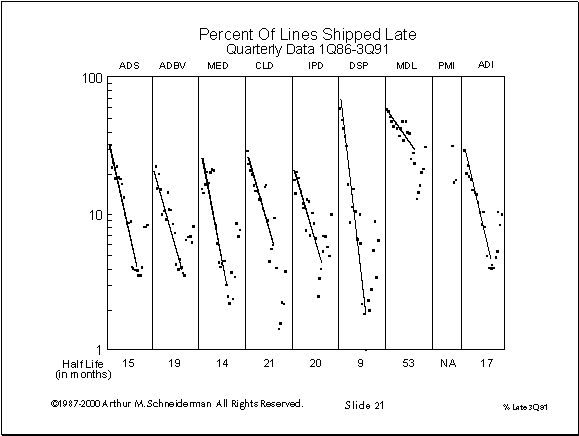
Now
the next chart I’d like to show you looks a little bit complex.
It’s not as complex as it looks. This
happens to be a history of improvement of the performance with respect to
delivery starting in first quarter of 1986, going to the third quarter of 1991.
Each of these columns here represents a division of the company.
The last column is the corporate aggregate.
The numbers that you see down here are the half-life.
The lines are computed during that period of time in which we were making
significant improvement.
So if you look here, for example, at the last column, and look across this slide, you will see that in the first quarter of 1986 we were about 30% late to our customers, and here we got up as high as 97% on-time in one quarter. In fact, for the year 1990 we averaged 96% on time. And, here’s that bubble, here’s that backsliding as we began to focus on other things. And in fact, if you conceptually click on these numbers here, you can get a time history of the half-life.
Slide 22

And from a performance measurement perspective, in a sense, this is the action line. This is what we’re looking for. If we’ve identified the right things to improve, then the metric is how fast are people improving? And so, we look at the half-life. And we watched during this period of time, we said nine months was our goal for this particular metric; this is pretty good, we’re getting there. Some of the divisions did have nine month half-lives for significant periods of times. But this is the point at which the half-life, the rate of improvement, flattened out (I don’t acknowledge negative half-lives. I won’t honor the unlearning process). So we look at the rates of improvement.
Slide 23

Now
this happens to be a more operational chart.
The one that I just showed you, looking over that long period of time is
suitable for meetings like this. But
it’s not very suitable for managing a company.
And so what we do is we look at the same kind of data, this is now
monthly data, rather than quarterly data. Each
of these columns, again, is a different division of Analog Devices.
The last column is the corporate total.
Yes,
you’re right, most of them are going in the wrong direction.
Things are getting worse. This
happens to be a newly acquired division. In
the process of doing all of this reorganization, all the changes within Analog,
we also made a major acquisition of a company about a third our size. That is a very big dinner to eat, let me tell you.
And there’s a lot of indigestion that ends up following that, and a lot
of distraction. But, they’re
learning the system and they’re making immense progress in terms of coming
down. The red line is a fit of the
half-life model through the data. There’s
twelve months worth of data on each of these.
Each month we add a point and we drop the oldest point, or the thirteenth
point.
The
green lines are very interesting. Many
of us in total quality management are also involved in statistical quality
control. And what statistical
quality control teaches you is that there is variability that is the result of
the process. And there’s
variability that represents an out-of-control situation.
Why don’t we apply that to our measurement system?
Doesn’t it make sense to apply things to the measurement system so that
we are not constantly chasing little random variations?
Before we did this, we wrote a report every month when we sent out this
data and if the division went up a little bit better we congratulated them.
If they got a little bit worse than the previous month we identified them
as a division that was not doing well.
And
yet, from a statistical point, if Dr. Deming were here talking to you he would
say that those are systems related. That’s
the randomness in the system. So we
do the same thing. We put control
limits on. We look at the latest
three months. If you’re above the
upper control limit, the upper green line, we change your dot to a red plus
sign. And if you’re below the
lower control limit it becomes a green plus sign.
And we use it the same way we use the scorecard.
It gets put up at the same meeting along with the other related charts.
All
of the metrics that we have, all of the ones I’ve showed you in terms of
delivery are in the same format. They
‘re in an on-line executive information system; the data is available on a
monthly basis. There are daily
downloads to each of the operations managers of every line that didn’t ship
that was scheduled for shipment the previous day. So they get daily information, which is how they are able to
find out what the root causes are.
Well you might guess that we’re a little bit paranoid at making sure that we connect what were doing internally with what’ s important to customers. We would not quite feel as if we had a full meal until we went and listened to what our customers had to say about our performance along the dimension we think they think are important. So we have a database that we maintain. It now has actually close to a hundred customers in it.
Slide 24
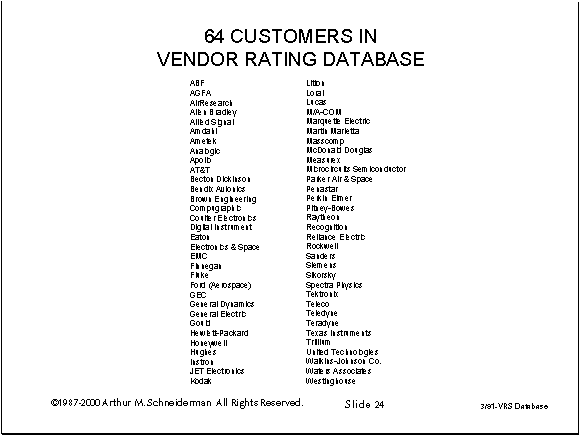
These
are customers that have what are called vendor-rating systems.
They measure various aspects of the performance of their suppliers, and
they rate them in someway or another and sometimes they actually provide that
information to their suppliers. It’s amazing the number of customers that we have that have
vendor-rating systems that measure quality and delivery and then they don’t
send that information to their suppliers. So
they know how well their suppliers are doing but they don’t tell their
suppliers.
Those that do and those that make their way into this database on a quarterly basis we publish a report and right now that report has two charts in it. It has our delivery performance and our quality performance as measured by those customers. We do no adjustment of the data. Even though we know that our customers make mistakes. We know for example in one of our customers that has a three day acceptance window for on-time delivery but occasionally material sits on their receiving dock for four days before it’s logged into their system and we’re able to track down the fact that we did get it to you on time. It’s just that your system did not accommodate it. It was there; you just did not know it was there. So we don’t correct the data for that, and this is what it ends up looking like.
Slide 25

Again
this is something we publish quarterly. On
average there are 22 companies in each data point.
So it is a statistically significant group of customers.
It’s the percent of late shipments as measured by our customers.
And it makes us feel very good because there’s a very strong
correlation between what they measure and what we measure, even though very
often they have different measurement systems.
Some
people have forgiveness windows of a week; if you’re a week late we’ll call
it on time. Some people have
three-day windows; there’s one particular customer that had three-day windows
said they’re going to change it to a one day window and the next time we’ll
be talking about acceptance windows in hours.
They all have different systems, but as you can see during the period of
time at which we thought we were between 20 and 30 percent late, low and behold
our customers thought we were between 20 and 30% late.
They saw improvement; they saw a little more rapid rate than we do, and
we think that that’s because their systems are a little more forgiving than
our measurement system. They’ve also seen the bubble.
They’ve seen our performance get worse over the last 18 months; it’s
something you can’t hide.
Well, as you remember on an earlier slide I said our goal was to be number one; rated number one by our customers in the value of the products we deliver to them. One customer that we have that actually does a very good job of taking all of the elements on the left side of that matrix: delivery, responsiveness, technology and really quantifying them and rank ordering their supplier is Hewlett Packard and Hewlett Packard does tell their suppliers how they rank.
Slide 26

In
1986 they told us we ranked #8 out of 16 suppliers. Now your first reaction to that might be “Whew, that’s
good, we’re in the middle of the pack,” but the second thing they told is
“By the way, we’re going through a vendor consolidation and we’re going to
reduce our supplier base of linear ICs from 16 to 8.”
So, in 1987 we made the cut. We
made it; they did it, they reduced their supplier base to eight and we made it
to fifth. Then they said, “By the
way we’ve thought about this linear vs digital ICs and since they end up going
on the same board and since the people in manufacturing don’t know the
difference we’re going to group them all together.”
Now
that was very important to us because linear IC suppliers are companies you
probably have not heard of. You
probably haven’t heard of Analog, and since most of our linear IC competitors
are much smaller than us, you probably haven’t heard of them either.
But the digital IC suppliers are Motorola, Texas Instruments, National
Semiconductor, Toshiba, NEC; a different group of competitors.
And their performance has always been significantly better than linear IC
suppliers. So we got real nervous
about that. But we kind of held our
own. They grouped them together;
there were now 15 and we were fifth.
By
1989 we had tied for first place. By
mid-1990, we actually reached first place.
But, the bubble. We have
dropped in their ranking system of suppliers since then. And that’s something we need to correct because they know
what’s going on. Customers know
what’s going on in your own organization.
Slide 27

Well,
my next to final slide is another measure, because again you’ve got to close
the loop on this whole performance measurement system.
Dataquest happens to be an independent industry organization.
One of the things that they do is a semiconductor supplier of the year
award that goes out to the manufacturers who exhibit extraordinary dedication to
product quality and customer service. They
identify those by poling 300 purchasing decision-makers: 200 in the US, 50 in
Europe and 50 in the Far East. And
in 1990, we were selected the mid-size semiconductor supplier of the year.
So, again another piece of evidence that suggests we’ve got the right
things on the left side of that matrix and we’re improving the processes that
drive that and our customers are getting greater value from us as a consequence
of that.
The Japanese model is that you have to be more weakness oriented than success oriented, but I can’t help telling you that there is a payoff if you do these things right.
Slide 28

I
think the things that we’ve learned, and again this is my opinion; this is not
necessarily something that others agree on, is that when we got up to 97% in
terms of, for example, delivery performance, we said “Hey, that’s good
enough. Let’s hold it there.”
My lesson is you can’t hold it there.
You either get better or you get worse.
Those are the two states. Now
maybe somebody will figure out a way of “holding the gains,” that’s a term
that Juran uses. But, we haven’t figured that out. My belief is that if you’re not on one of those half-life
curves, if you try to back off: instead of meeting once a month, meet once a
quarter to work on quality improvement, you’ll get worse.
So I think that it is not an analog process, not a continuous process.
It’s digital: you’re either improving or getting worse.
Secondly,
it’s very easy to get distracted, even for the right reasons.
We talked earlier about why we were centralizing.
Those are the right reasons. This
division that we acquired, that in fact caused us a bit of indigestion, was the
right decision. It rounded out our
product line in a very important way from the perspective of our customers. Right decisions. We’re
changing our business planning process; it’s the right decision.
On the other hand, doing all of these things, recognizing that there is
finite human capacity in an organization, people can do only so many things.
As a consequence of that it’s very tempting to put TQM on the back
burner. The success almost leads to
complacency, that you can kind of hold your own.
I don’t think you can do that. I
think that this other area here is a very critical one that we’re only now
beginning to understand.
I
mentioned the slack rope model from Duncan McDougall. It is there; let me tell you.
Let me give you an example of it. Financial
pressure: one way of dealing with financial pressure is cut back on capital
investment. The accounting system
says the utilization rate is about 70%, just cut back.
Don’t replace that piece of equipment.
What
happened is that our unit volumes have been increasing more rapidly than our
revenues have been increasing. And
our capacity [utilization] started rising in manufacturing.
Many of you are from manufacturing.
You know what happens as you start getting to 80% utilization, 85%
utilization, 90% utilization, now you have a problem.
That happened, yet no capacity to recover.
If you try to recover [from] that problem then you’re going to late on
the new batch of shipments because you don’t have the additional capacity.
So
a simple decision made up the organization to cut back on capital investment
inadvertently affected our ability to deliver on time to our customers.
So that slack is out of the system.
We have to understand the linkage between vertical decision-making and
the result that it has on the things that people are working on.
Horizontal:
we’re to the point now where we can’t improve our yields without redesigning
our products. So it’s no longer a
manufacturing process engineering exercise, it’s an exercise that brings the
design community into the process. You
can’t improve without getting other functions involved.
So the slack is out of the model.
I
know you’ve got a question here, but let me just finish this one slide and say
that what it really leads you to is this last point of monitoring.
I said that before. The best
measurement system in the world, if you don’t make it highly visible, you
won’t get any results from it.
And
finally, I think that the TQM implementation process itself represents a series
of breakthroughs. You put in one
paradigm for continuous improvement, eventually you run out of steam; you now
need a breakthrough. You need to
now fundamentally change the way you’re implementing TQM. There are many companies that are at the first stage; there
are few companies that are at the second stage.
I don’t know of any companies anywhere in the world that are at the
third stage. I don’t even know
what the third stage is. But I’ll
tell you there are stages, and one of the things that we all have to begin to
recognize is that we’re dealing with a world that is going to be continuously
changing. Whether it’s
performance measures that we’re talking about; whether it’s manufacturing
that we’re talking about, the targets that you set are moving targets and
they’re going to be shifting over time.
And,
there’s a new approach that people have to take. That there are no anchors; there are no things that you can
say “this is a stake in the ground, this is a way that I can think about my
business for the next decade.” It’s
going to change.
So
let’s now talk about more questions and I know that there was one over here.
Q:
Oh
yes. I think that people capacity
is an issue that people have not talked about nearly enough.
But there’s actually another interesting dimension of that.
Just imagine for a moment a quality improvement team working on yield
improvement. They meet every week
for an hour; a group of five or six people, and they sit around there and they
go through that 7-step process.
There’s
always a critical creative moment in that process when people now understand
what the rood cause is and somebody has to trigger the process of coming up with
corrective actions. There are these
five people. We’ve been meeting
for three years. In fact if you
looked at our yield numbers there, between 1987 and 1990, we doubled the yield.
Now, from a manufacturing perspective what that means is the effective
capacity of our equipment doubled. Equipment
that was in place doubled in capacity because our yields went up.
We were getting twice as much good product each hour that we operated
that machinery.
Now
as a consequence of that, what happens to the financial accounting systems?
Labor variances go up because you’re not generating enough product to
absorb the costs. So the message
comes down from the accounting department “Lay off people.
You’ve got too many people.” And
in fact, you do! If you don’t
grow the volume of your business as rapidly as you’re improving, then your
utilization rate goes down, not up. And
so in some areas, our utilization rate went down.
Suddenly
it’s time for our weekly meeting, only four people! “What happened to Sally?
She got laid off! Why’d
she get laid off? Well because we
improved. Oh, I know what to do
next about that.” This whole
restructuring issue raises a whole bunch of questions in terms of conflicting
signals. And when you talk about
the Japanese in terms of lifetime employment, and you talk about Deming in terms
of lifetime employment, and you experience continuous improvement and the effect
that layoffs have on the whole incentive associated with continuous improvement,
you realize that there is an issue that management has to face.
They have to manage that issue, because if you don’t manage it turns
off the improvement process.
So
there are all kinds of issues around human capacity, equipment capacity.
Right now, what I’m arguing with our accounting people is that we ought
to justify capital investments in manufacturing based on 70% utilization rate
until we are able to eliminate variability from the manufacturing process, which
probably won’t occur during my career. We
need to say that you don’t design a factory to operate at 90%; you design a
factory to operate at 70%. So if
you have the capacity in place, both people capacity and equipment capacity, to
deal with variation in the system. And
you can take that 30% of the time with people, you can train them, you can have
them work on continuous improvement activities.
There are lots of very useful things that you can do with people that
aren’t producing product.
Chairman:
We have time for a couple of more questions.
Q:
When your utilization went down, your profit didn’t necessarily follow, for
example, and could you not have shown that to the executive people?
No,
our profit didn’t go down, but it didn’t go up. And so here’s a great opportunity to increase profit:
eliminate people. The fact that
direct labor…
Q:
How could you make that decision?
Well,
we made that decision. That’s an
“up one.” The slack is out of
the rope when you start making decisions at the executive level that send
conflicting messages, partly because you’re a spectator.
Now I think we’ve passed that point at Analog. I mean this is a very exciting time at Analog because all the
issues that I’m sharing with you are issues that we talk about every day at
Analog. And we’re struggling with
them. They’re not simple issues.
On the one hand we’ve got survival of the Corporation.
It doesn’t do any good to have lifetime employment for people when the
net result is nobody’s employed. There
are all kinds of very complex issues here and they can only be addressed when
you start driving TQM up the organization and get those people to be debating
the kinds of issues that we’re talking about here.
Q:
Do you have automated systems for collecting the data or do you have
hordes of people collecting the data?
Good
question. On the on time delivery
metrics we did that through our corporate centralized order entry system.
There was a team that I put together of five people who worked for a
period of about two years in putting together that measurement system.
Very detailed, very comprehensive, very expensive.
Now
I told you that Professor Shiba, when he comes to visit us looks at some of the
things that we’ve done that I’m particularly proud of and he says “bad.”
His model is very different and any of you who have dealt with the
Japanese may have experienced this. That
model basically is you don’t need a fancy information system in order to
collect TQM data. You do little
experiments. Go out, pick 50 orders
out. Look at those 50 orders.
Were they all on time? Were
they not on time? If 50’s not big
enough, pick a hundred out. Do an
ad hoc experiment. Don’t build
big systems. Now, that’s another
open issue.
We’ve
got a lot of very exciting open issues. One
model basically says, and it’s the model I use… the slide that I normally
put up to start my presentation has information systems right in the middle of
it. It’s three over-lapping
circles, right in the middle is information systems, because I’ve always felt
that information systems is the key to accelerated improvement.
But the Japanese model’ s very different: ad hoc, no formal systems, no
big systems.
Q:
Art, you said you hand out some copies of your …
Yes, there’s a sign out sheet out there. I’ll be making copies of all of the slides that I showed you. They will go out to you. If any of you want more details on this half-life method drop off your business card and I’ll put together a little package that has a very interesting Harvard Business School case that has been written on the pros and cons of that approach.