Goals©
by
Arthur M. Schneiderman
Goals subsume improvement of internal processes.
Goals describe a quantifiable desired future state of the organization. In general, goals can not be achieved by doing business as usual. If "doing what you did, will get you what you got" is good enough to satisfy your long term goals, then just carry on business as usual. It is unlikely that most of the materials covered in this website (with the exception of process control described in my 7-Steps of Process Management) will be of significant help to you. Just keep doing things the same way and you should expect similar results.
But most organizations can't satisfy their long-term, stretch goals by doing business as usual. Even successful organizations need to evolve in order to survive in our rapidly changing competitive environment. They require changes or improvements in the way their business is done.
Goals are a measurable expression of strategy and tactics.
I like to think of goals by analogy to coins: both have two sides. For coins it's heads and tails, while for goals it's strategy and tactics. The strategy part of a goal is its "what" side: >25%/year average growth, >10% after-tax profit, and >2x relative market share. The tactical side are the principal "hows" of the strategy's implementation: "to be rated #1 by more that 50% of our customers in total value delivered by 1992." Taken together, they represent the articulation of the highest level goals of the organization.
High-level goals are directly linked to strategic gaps in stakeholder satisfaction.
Goals represent a set of highest level outcomes consistent with the organizations Vision, Mission and overall Objectives. At Analog, we identified our long-term goals by looking for common elements of our strategy toward our primary constituents or stakeholders: customers, employees and stockholders. I used the following graphic (c. 1989) to symbolize that thought process:
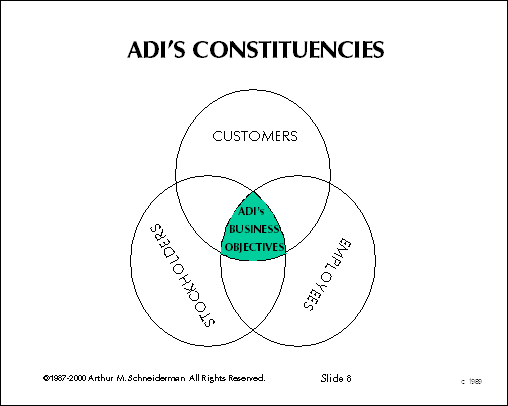
In this Venn diagram, each circle represents the entire set of requirements for that particular stakeholder. The area where all three circles overlap represents the set of shared requirements which I called ADI's Business Objectives. Where any two stakeholder circles overlap, I tried to capture their principal mutual expectations. For example, stockholders satisfy employees need for capital while employees generate the expected return on that investment. The resulting business objectives, though deceptively obvious on the surface, were continued growth, profitability and market leadership.
Short-term goals keep us on track to our long-term destination.
It is always useful to break long-term goals down into intermediate annual objectives. These short-term goals represent a complete set of milestones on the path to achievement of the long-term goals. Intermediate goals do not generally follow a straight line to the long-term goal. Most of the time, initial progress is more rapid since difficulty tends to increase as the goal is approached. This is exactly the opposite of what happens if intermediated goals are not set. Our natural tendency to substitute short term "crisis" activities over work toward long term goals means that nearly all progress needs to be made as the journey's end is approached. This procrastination is the source of the common hockey stick curve which connects to-date and projected progress toward the goal.
Goal deployment translates high level strategies into individual action plans.
As goals are deployed down the organization, one level's tactics becomes the next levels' strategies. The what-how spiral is the vehicle by which the highest level strategy is translated into the detailed tactical plans at the level of every action agent. This deployment process was first developed in Japan in implementing Hoshin Kanri, a near relative of the balanced scorecard.